
An educational video series exploring Nisenan history, Cultural resources, Indigenous land stewardship, and what it means to live in respectful relationship with Nisenan Ancestral Homelands.
What does it mean to live on Nisenan Ancestral Homelands?
How might understanding the history of the Land change the way we care for it?
And what responsibilities and opportunities do property owners, residents, and community members have to build meaningful relationships with the Original People of this place?
These are some of the questions explored in a new four-part educational video series featuring Shelly Covert, Tribal Spokesperson for the Nevada City Rancheria Nisenan Tribe and Executive Director of HUṠWEJ, and Saxon Thomas, HUṠWEJ Land and Cultural Research Director.
Originally recorded for members of the Nevada County Association of REALTORS, these conversations offer valuable insights for anyone who lives, works, owns property, or spends time on Nisenan Homelands.
Together, Shelly and Saxon invite viewers to look beyond the familiar landscape and consider the generations of Nisenan People who lived in reciprocal relationship with these Lands since time immemorial, the profound disruptions of the gold rush, and the ongoing work of the Tribe to restore Cultural connections, steward Ancestral Homelands, and strengthens Tribal sovereignty.
The Nisenan Are Still Here: Community, Visibility, and Rematriation
For many local residents, understanding Nisenan history begins with recognizing that the Nevada City Rancheria Nisenan Tribe is a living Tribal community whose history extends far beyond the gold rush and the first encounters with the European settling of California.
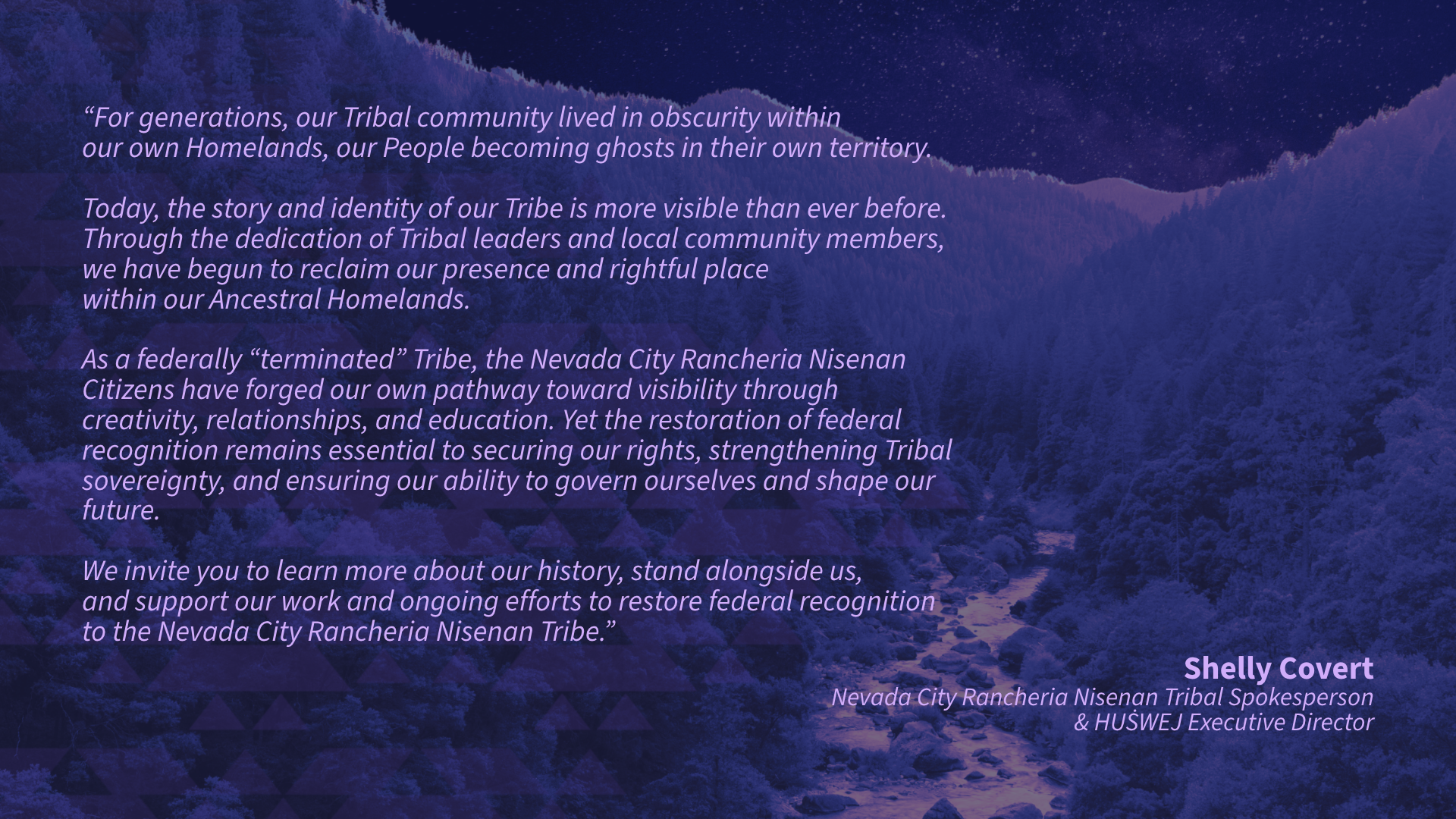
In the first conversation, Shelly and Saxon introduce the Tribe, explore the consequences of federal termination in 1964, and discuss the importance of reclaiming Nisenan visibility and identity.
They also share the story of Yulića, 237 acres of Nisenan Ancestral Homelands recently rematriated to the Tribe, and the significance of rematriation for reconnecting Tribal families with Land, Cultural practices, and community.
The conversation invites viewers to consider how learning accurate Nisenan history, supporting Tribal initiatives, and building reciprocal relationships can contribute to the Tribe’s ongoing efforts to reclaim its visibility, revitalize Cultural practices, restore relationships with Ancestral Homelands, and advance Tribal sovereignty and self-determination.
Reading the Land: Understanding and Protecting Cultural Resources
What should you do if you discover a grinding rock, an arrowhead, or another potentially significant Cultural resource on your property?
What do these resources reveal about the People who lived here before the gold rush?
For property owners, questions about Cultural resources can sometimes bring uncertainty or concern.
In the second conversation, Shelly and Saxon explore how the landscape holds evidence of generations of Nisenan life, including village sites, gathering places, and the tolls and resources associated with everyday Cultural practices.
They emphasize the importance of leaving potential Cultural resources undisturbed and recognizing that these places and objects may hold information essential to the Tribe’s understanding of its own history.
Rather than approaching Cultural resources as isolated artifacts, viewers are invited to consider their place within a much larger Cultural landscape and the importance of protecting that history for future generations.
Good Fire: Indigenous Land Stewardship and Wildfire Resilience
Long before contemporary conversations about wildfire mitigation and forest management, Nisenan People maintained sophisticated relationships with the Land through generations of observation, tending, and Cultural Burning.
In the third conversation, Saxon and Shelly explore the role of fire in maintaining healthy ecosystems, supporting native plants and animals, and sustaining the resources upon which Nisenan communities depended.
They also discuss the ecological and Cultural consequences of suppressing Indigenous stewardship practices, and the importance of reintroducing “good fire” to the Land to support ecological health, wildfire resilience, and the revitalization of Nisenan Cultural traditions.
Today, HUṠWEJ’s Tribally-guided Stewardship Crew is helping restore these relationship through hands-on tending, ecological restoration, and the revitalization of Indigenous Traditional Ecological Knowledge (ITEK). Guided by Nisenan Cultural knowledge and priorities, the Crew’s work supports the health of Nisenan Ancestral Homelands while restoring Tribal relationships with fire and revitalizing some of the Cultural practices that have sustained these Lands since time immemorial.
For contemporary landowners, this conversation offers an opportunity to reconsider what responsible land management looks like, moving beyond simply clearing overgrown vegetation toward understanding the interconnected health of the landscape and the generations of Indigenous knowledge that have shaped it.
Living on Nisenan Homelands: Honoring the Land and Its History
There is something undeniably special about the Sierra Foothills. Many who live here feel a deep connection to the Land, its Rivers, Forests, and Mountains, and a sense of responsibility to protect the natural beauty and ecological richness that make this region so extraordinary.
In the fourth conversation, Shelly and Saxon honor this connection while inviting viewers to deepen their understanding of the Land’s history and the generations of Nisenan People who have lived in reciprocal relationship with these Homelands since time immemorial.
They explore the importance of acknowledging the truth of what happened to the Indigenous People, the Land, and the Animal-kin during the gold rush, while recognizing the sophisticated knowledge, Cultural practices, and relationships through which Nisenan People tended and sustained these Lands for thousands of years.
For those who call this place home, the conversation offers an invitation to move forward together: learning from Nisenan Traditional Ecological Knowledge, advocating for the protecting and healing of the Land, and building relationships grounded in shared stewardship, respect, and reciprocity.
Continuing the Conversation
Understanding the history of Nisenan Homelands is an ongoing process, one that invites curiosity, thoughtful questions, and a willingness to deepen our relationships with the places we call home and the Original Peoples of these Lands.
Through these conversations, Shelly and Saxon offer an opportunity to learn directly from Nisenan Tribal leaders, broaden our understanding of the Land, and consider how greater awareness can grow into meaningful relationships grounded in respect, responsibility, and reciprocity.
We invite you to continue learning about Nisenan history, Culture, and contemporary Tribal life through the educational resources available on HUṠWEJ’s website.
We also encourage you to explore the work of HUṠWEJ and the many ways the Nevada City Rancheria Nisenan Tribe continues to care for its community, restore relationships with Ancestral Homelands, and share its knowledge and leadership for the benefit of the Tribe, the Land, and the broader community.
An important part of this work is the Tribe’s ongoing effort to restore its federal recognition, a critical step toward strengthening Tribal sovereignty, securing essential rights and resources, and expanding opportunities for the Tribe to protect, steward, and heal its Ancestral Homelands for the benefit of the Earth, future generations, and the broader community.
By engaging in reciprocity with the Tribe, we can help support this ongoing work and contribute to a shared future rooted in understanding, healing, and collective care of these Lands.