
A Gateway to Nisenan Ancestral Homelands
On a wooded ridge overlooking Deer Creek Canyon, a new gateway rises from the Land. Its sweeping archway is woven from willow and ceanothus, crowned with great wooden feathers, and transformed by fire.
Known as ṡam je· (sahm-yeh), meaning “fire feathers” in Nisenan, the gateway was created through a collaboration between the Nevada City Rancheria Nisenan Tribe, artist Jenny Hale, and the Bear Yuba Land Trust (BYLT), with contributions of many local craftspeople, Tribal Members, and volunteers.
It stands as both a work of art and an invitation: to step into another way of seeing, to encounter ancient histories held within the Land, and to recognize the Nisenan People who have belonged to these Ancestral Homelands since time immemorial.
Along the Path of Ancestors
Situated within the Wildflower Ridge Preserve in Grass Valley, the gateway stands upon a natural crest where the Land opens to sweeping views across Deer Creek Canyon, and when the skies are clear, toward ˀeṡtom janim, the Nisenan sacred mountain (known today as the Marysville Buttes).
The area now known as Wildflower Ridge Preserve lies along an ancient trail that once connected Nisenan townsites and communities. For countless generations, Nisenan People traveled the ridgelines and river crossings of their Ancestral Homelands, following pathways that wove between what are now known as Bridgeport, Rough & Ready, and Grass Valley. These routes formed a living network of connection across the landscape, carrying generations of movement, exchange, and relationships between Nisenan communities and the Land they have belonged to since time immemorial.
The placement of ṡam je· along this ancient network of pathways carries a beautiful continuity of meaning: a sculpture born through collaboration and relationship now stands in a place where communities have traversed the Land since time immemorial, honoring the relationships that have shaped this landscape while inviting new ones to unfold.
Feathers, Flight, and the Power of REturn
The California condor, a bird of profound Cultural significance to the Nisenan People, was an early inspiration for ṡam je·. As the artistic vision developed, Jenny Hale adapted the original design, moving away from the condor's enormous, elongated feathers toward a form that more broadly evokes flight, freedom, and the possibility of transformation.
The condor's symbolism, however, remains a meaningful part of the gateway's story.
Once pushed to the edge of extinction, the California condor has become an extraordinary example of revitalization. Through sustained restoration efforts, condors are gradually returning to Lands from which they had nearly disappeared.
The parallel with the Nisenan People is deeply resonant.
Following the devastation of the gold rush, generations of violence, displacement, and the suppression of Indigenous identity and Cultural practices, the Nisenan were rendered nearly invisible within their own Ancestral Homelands. The termination of the Nevada City Rancheria's federal recognition in 1964 compounded this erasure.
Yet the Nisenan never disappeared.
Today, the Tribe is increasingly visible across its Ancestral Homelands — revitalizing Cultural practices, restoring relationship with Land, reclaiming places of Cultural significance, and advancing its sovereignty and self-determination.
Like the condor, the Nisenan story is one of enduring presence and resurgence.
The gateway's sweeping feathers evoke flight, freedom, and the possibility of renewal, honoring the resurgence of the Nisenan People and the reclamation of Cultural traditions, Ancestral relationships, and connections to the Land.
Fire as Relative, Protector, and Renewer
Fire is equally central to the gateway’s meaning, both symbolically and materially.
For the Nisenan, Fire is kin and relative – a powerful presence within the living landscape, and an essential part of the reciprocal relationships through which the Land has been tended since time immemorial.
Fire also holds profound spiritual significance within Nisenan Culture. As a cremation society, the Nisenan traditionally use Fire to release the spirits of those who have passed, allowing them to return to ˀeṡtom janim, the sacred mountain, on their journey back to the Milky Way.
The spiritual significance of Fire extends to the natural world, where it releases the spirits of plants and other organic matter, allowing their ongoing cycles of death, transformation, and renewal. Its ecological function reflects these same cycles, clearing away what has completed its life while creating the conditions for Land to regenerate. Fire stimulates new growth, renews habitats, and supports the abundance of life that depends upon healthy ecosystems.
This understanding of Fire as a sacred, life-giving, and transformative presence became foundational to the artistic process of creating ṡam je·.
The gateway’s wooden feathers were crafted from locally sourced incense cedar, a Culturally significant species for the Nisenan, then carefully charred using the Japanese wood-preservation technique known as shou sugi ban (also called yakisugi).
Through the careful application of flame, the wood is transformed. Intricate patterns emerge from the grain, revealing a striking interplay of dark, silvery-black textures and warm, exposed wood. The process also helps protect the cedar from moisture, decay, and beetles.
Here, fire becomes an active collaborator in the artwork, revealing the beauty of the wood while helping preserve it for generations. When approached with intention and care, the same Fire that revitalizes the Land becomes a source of protection and transformation within the artwork, enhancing the beauty of wood sculpture while preserving it for generations to come.
Materials That Carry Meaning
Every material incorporated into ṡam je· contributes to its story, carrying layers of Cultural, ecological, and historical significance.
At the heart of the sculpture is a strong metal framework, deliberately designed to stand for generations. For the Tribe, whose presence has been systematically erased from public consciousness within its own Ancestral Homelands, permanence carries particular significance. The gateway stands as a lasting testament to the Nisenan People, their history, and their enduring presence within these Lands, affirming that they will never again be rendered invisible in their own Ancestral Homelands.
Around these metal bones, locally gathered willow forms the woven body of the archway, while ceanothus, another Culturally significant Native plant, is incorporated into its interior. Both native plants carry deep connections to Place, reflecting generations of Nisenan Cultural knowledge and relationship with the natural world.
As part of the creative process, Tribal Members gathered alongside project artists to weave these native plants into the gateway’s interior. Through their hands, the sculpture became an expression of living Cultural continuity, bringing together Ancestral knowledge, contemporary creativity, and the plants of Nisenan Ancestral Homelands. Each woven branch carries the care and intentions of those who shaped it, grounding the artwork in the Land itself and the enduring relationship between Nisenan People and Place.
When additional reinforcement of the gateway was needed, volunteers sourced exceptionally durable Black Locust wood from a nearby property. Introduced to California by settlers and miners during the gold rush, its presence offers an unexpected layer of symbolism: a tree associated with settlement now helps support a structure honoring the Original Peoples of this Land. Here, it becomes a reflection of the possibilities for reciprocal relationship between Indigenous and non-Indigenous communities, grounded in respect, understanding, collaboration, and meaningful support for Tribal revitalization.
A Gateway Through Time
ṡam je· is envisioned as the centerpiece of a larger immersive experience at Wildflower Ridge Preserve. The gateway will eventually become part of a walking loop through the surrounding landscape, with plans for an overlook oriented towards ˀeṡtom janim, the sacred mountain visible on the distant horizon.
At the heart of this experience is the gateway itself, a symbolic portal through time. Thresholds hold a particular kind of power, inviting us to shift our perspective, step beyond the familiar, and become aware of dimensions of Place that might otherwise go unnoticed.
Passing beneath the great feathered arch of ṡam je· invites visitors into the deeper layers of time and memory held within the Land. The gateway invites us to experience the Land through a different lens, to step into a living history that continues to unfold, and to consider our own place within a place shaped by generations of movement, connection, and reciprocal relationship between Nisenan People and their Ancestral Homelands.
The Magic of Creating in Relationship
Across the work of the Nevada City Rancheria Nisenan Tribe and its nonprofit HUṠWEJ, projects seem to take on a life of their own, calling forward the people, resources, and connections needed to bring them into being. What begins as a vision gradually becomes something larger, shaped by the collective gifts of those who feel connected to the Land, the Tribe, and the possibilities of what can be created together.
ṡam je· offers a beautiful example of this phenomenon.
In consultation and collaboration with the Tribal members, Jenny Hale led the artistic vision and design and worked alongside metal fabricators Kris Kopp and Ron Moore to establish the gateway’s structural and feather framework. Woodworker Elizabeth Dieter brought the feathered elements to life, transforming incense cedar into intricately textured forms shaped and protected through fire.
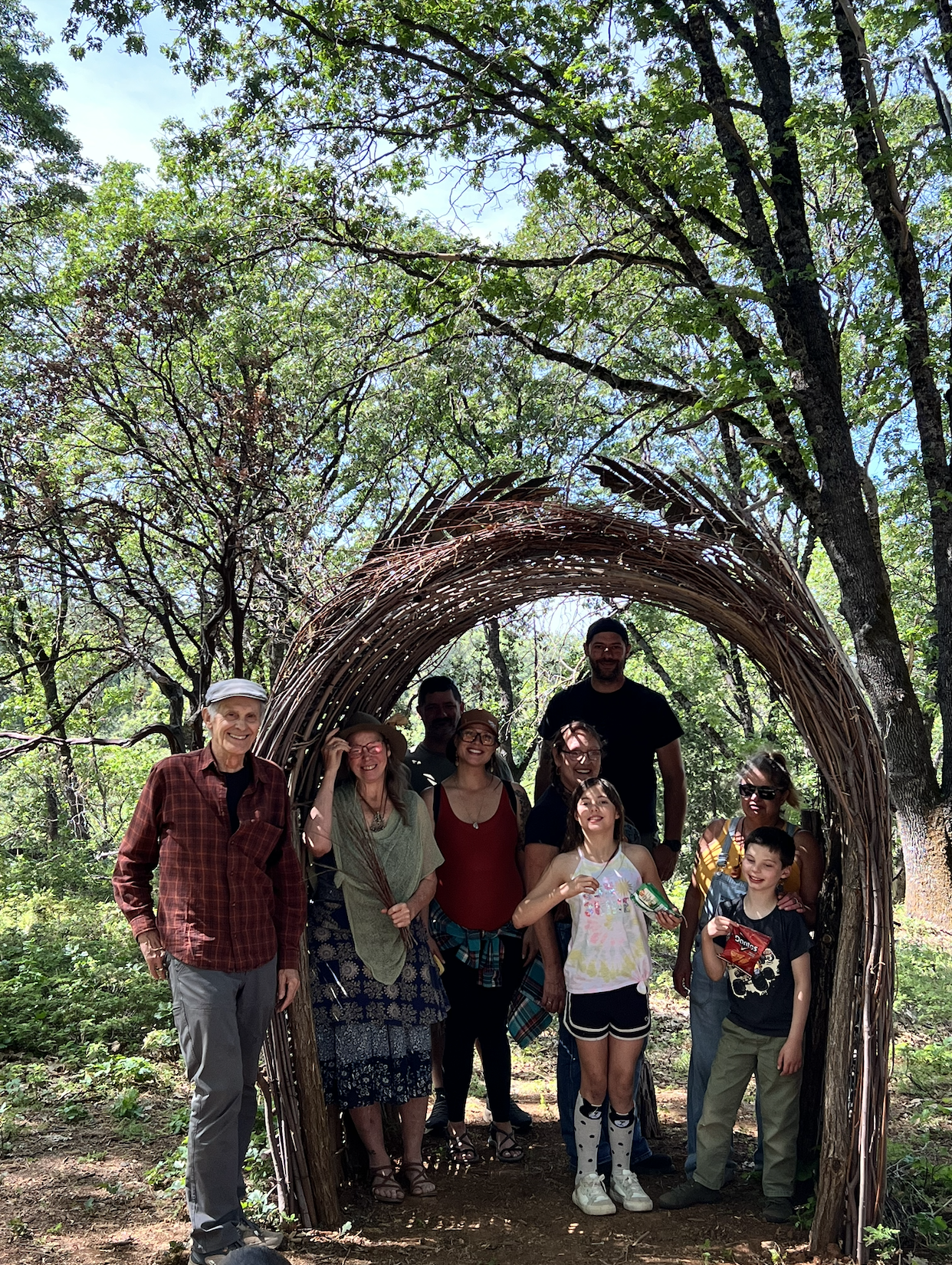
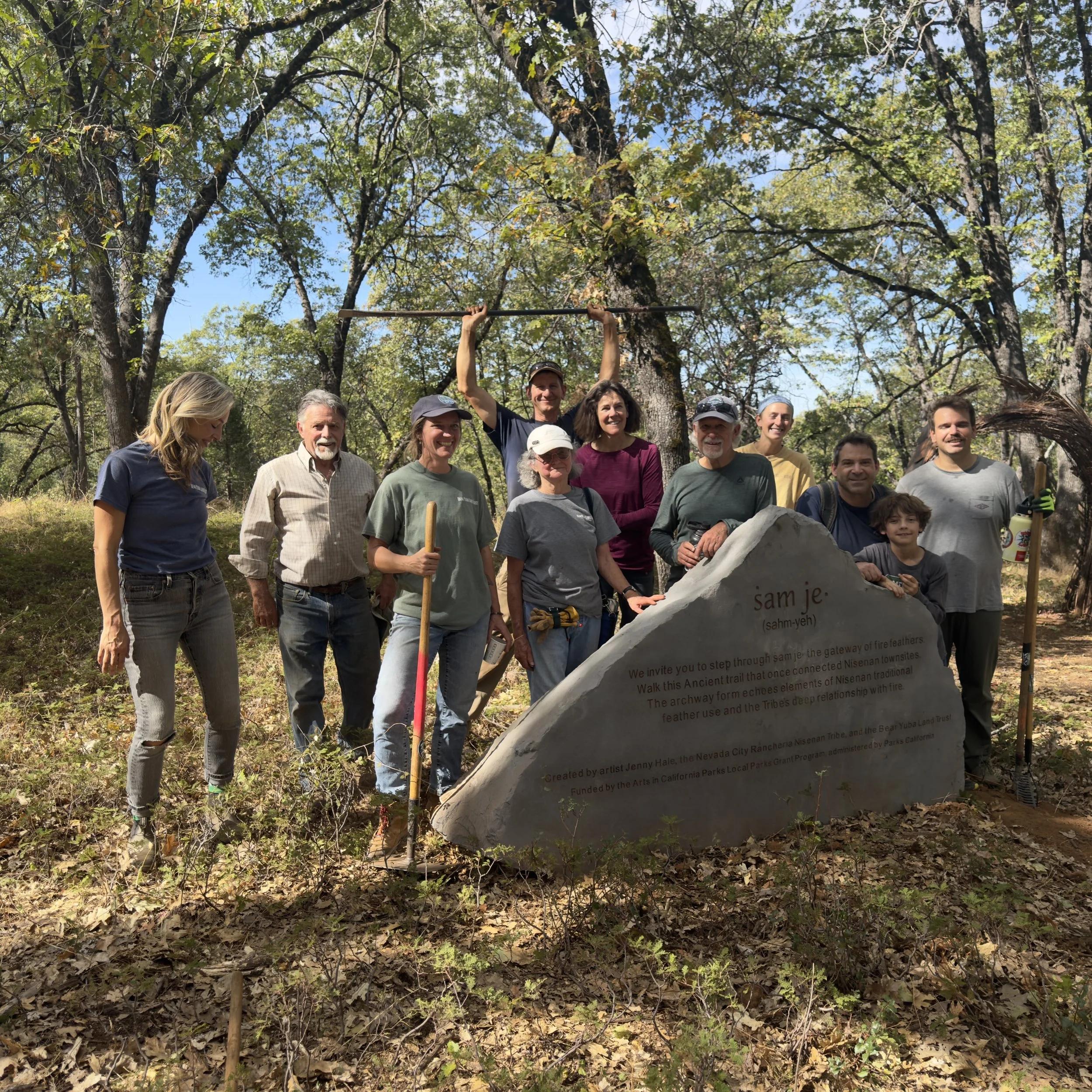
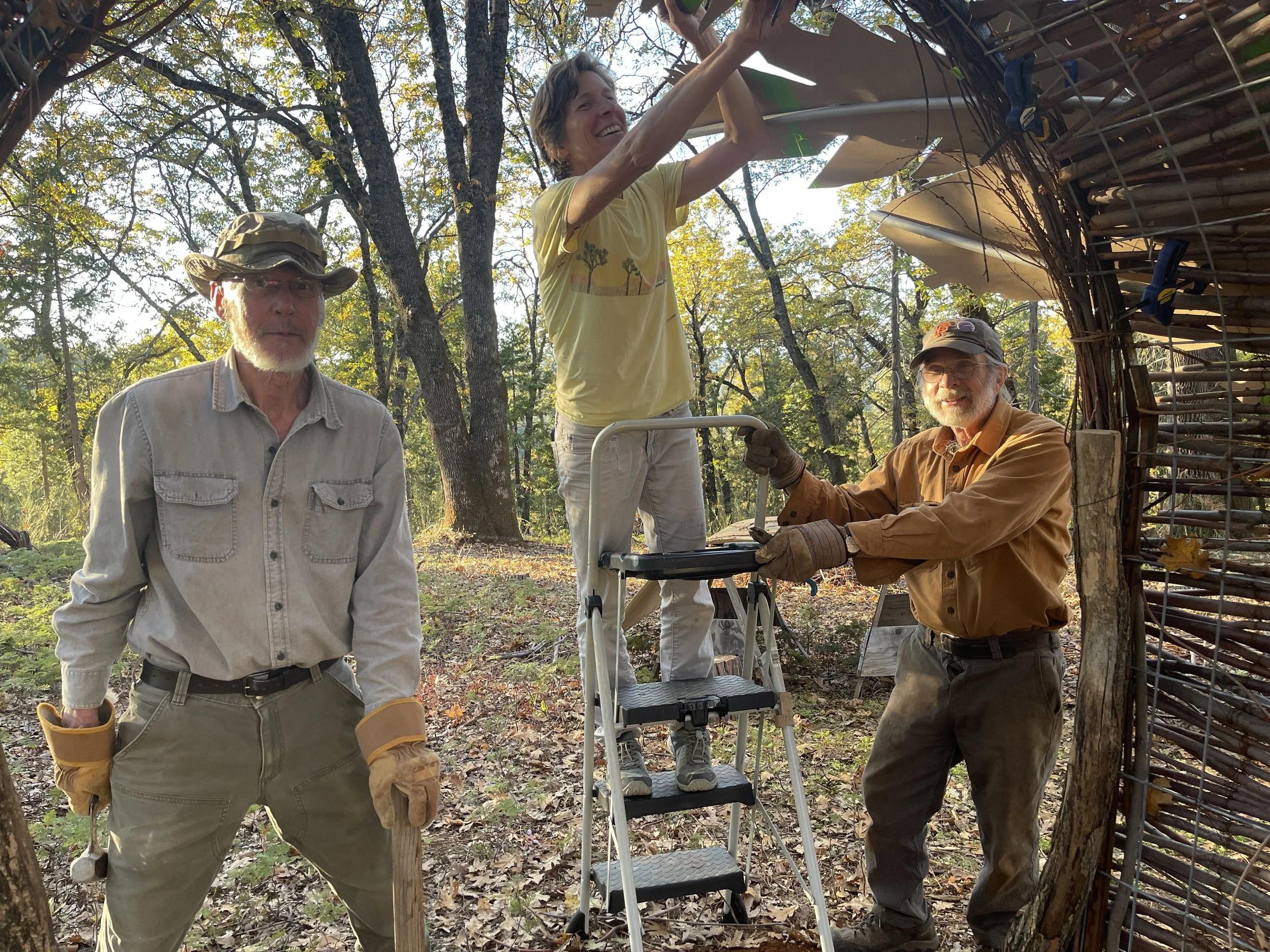
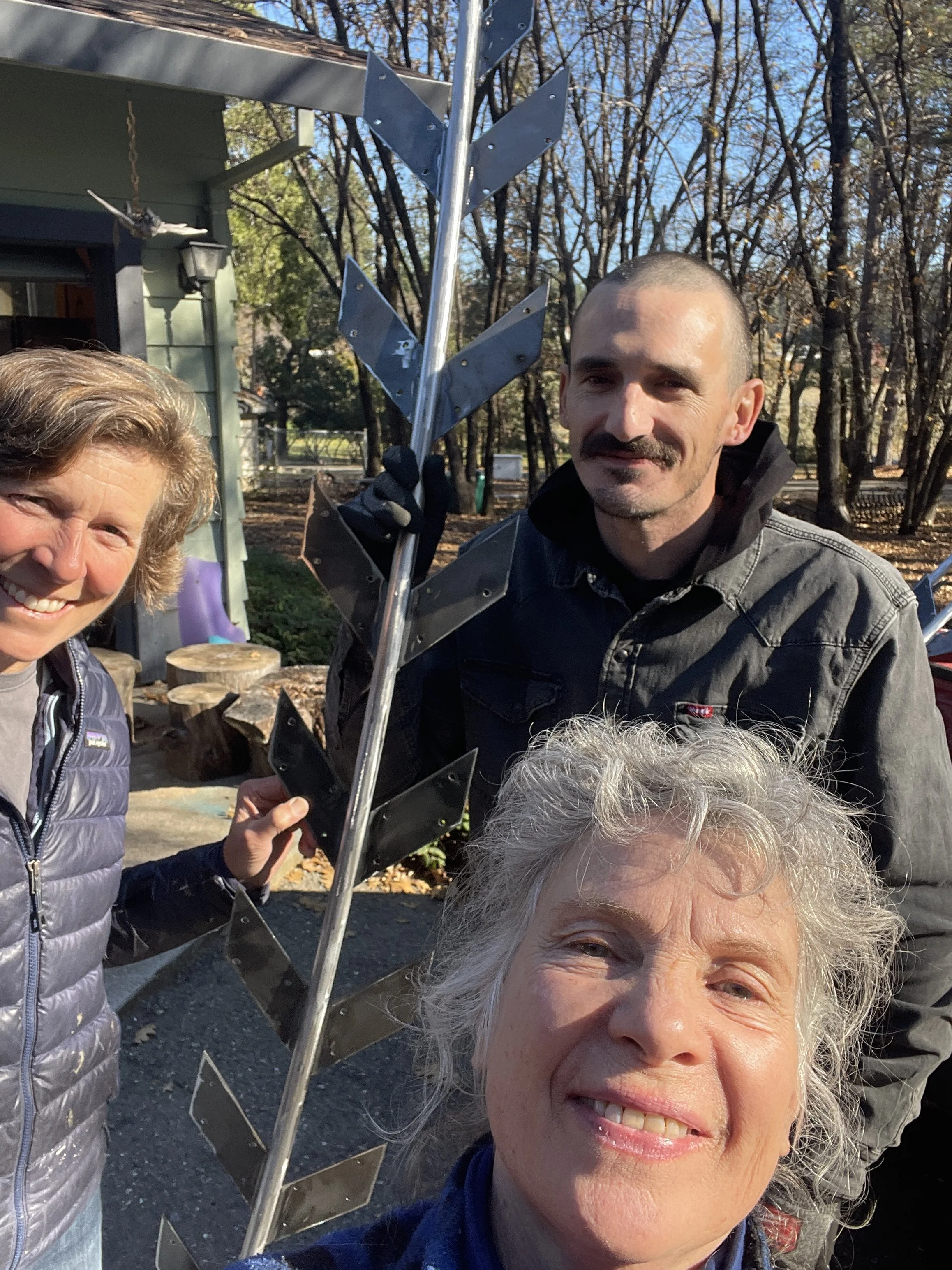
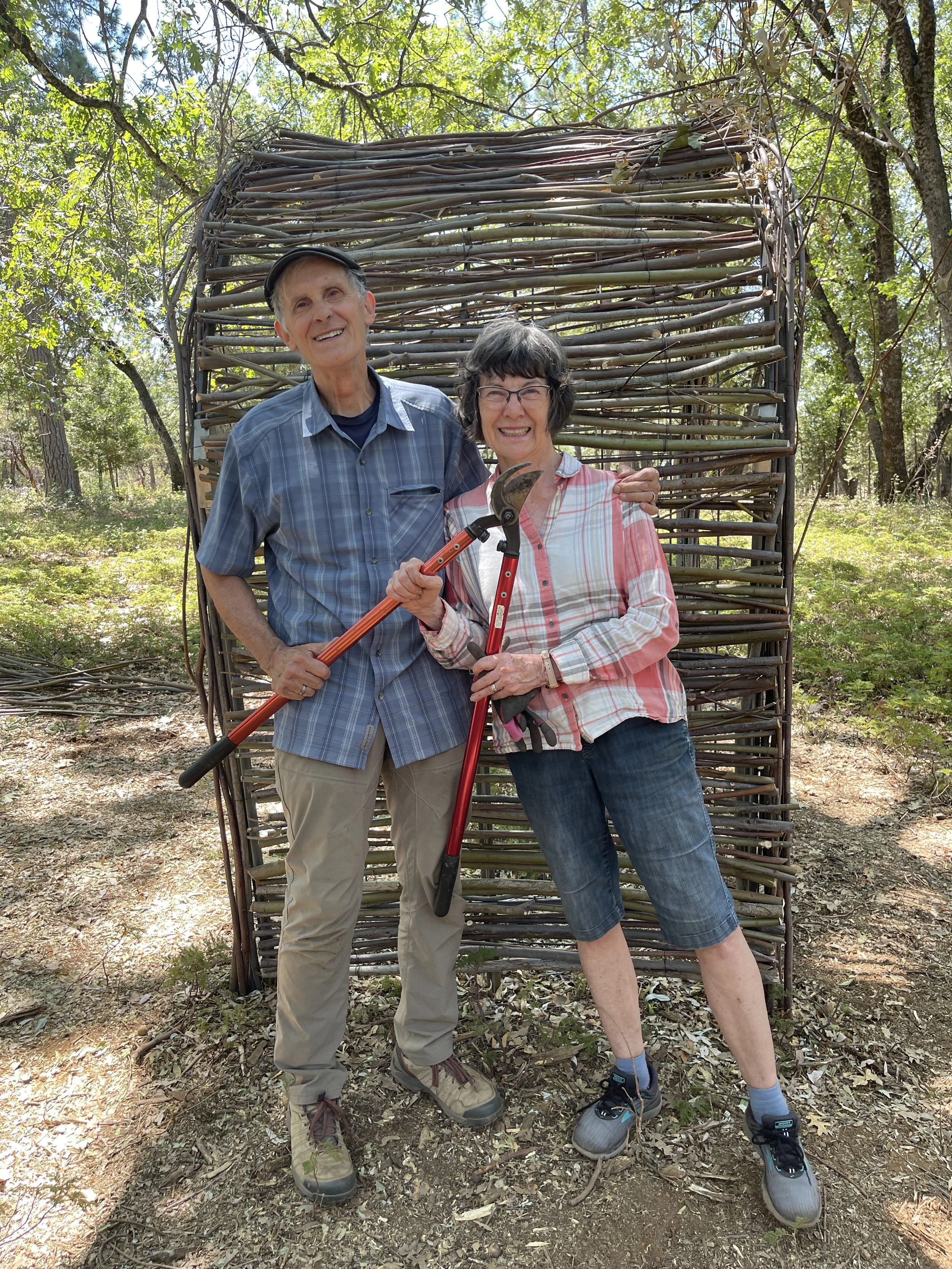
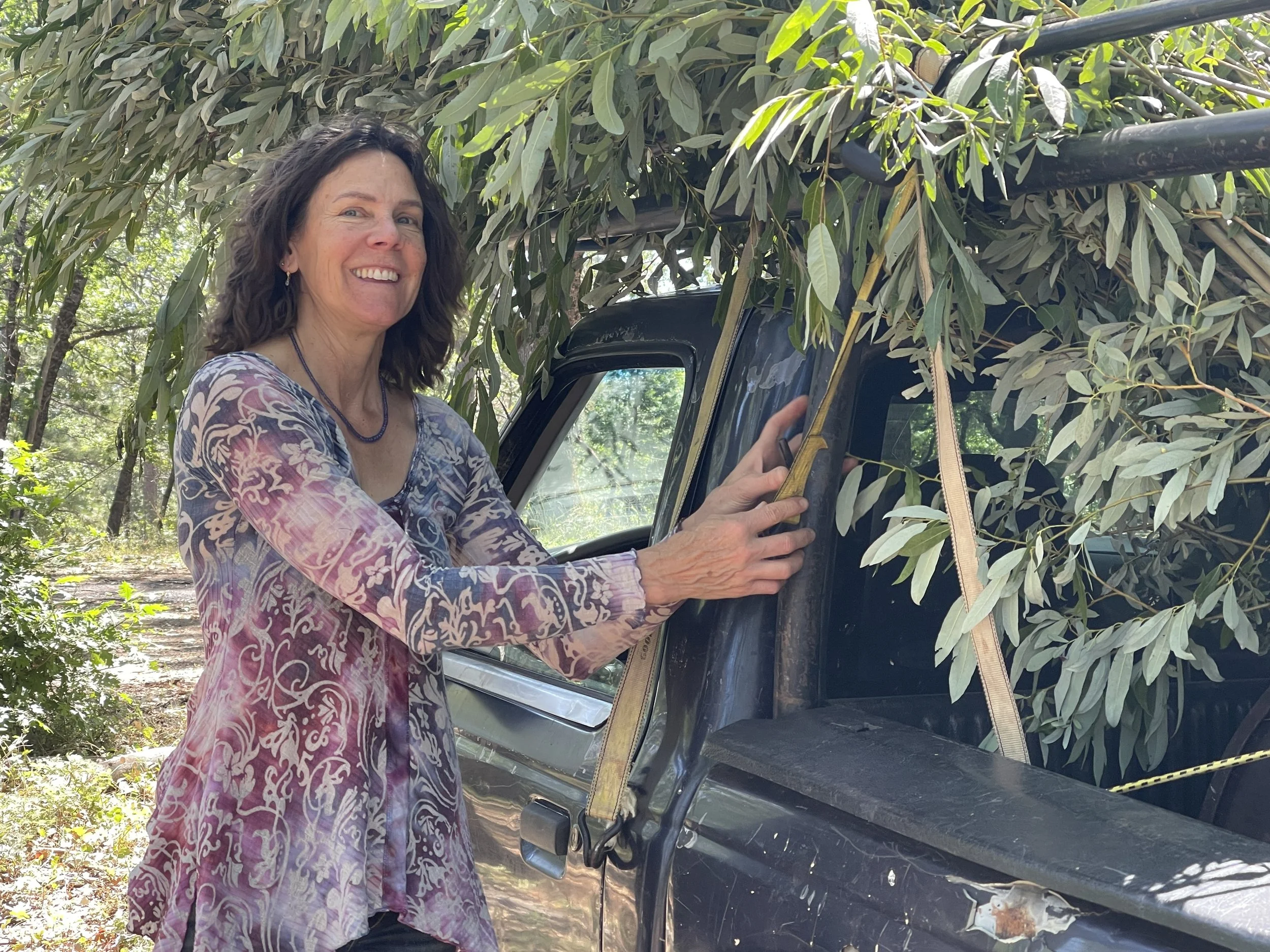
Volunteers Colette Castro and Mike McLean helped assemble and weave the willow exterior, while Bear Yuba Land Trust volunteer Julie Herrlinger helped gather materials. When additional structural reinforcements were needed, volunteers Jonathan Keene and Ralph Silberstein brought their expertise and resourcefulness, sourcing Black Locust from Ralph’s property to strengthen the foundation.
Tribal Members also gathered alongside local weavers Laughter and Star to incorporate willow and ceanothus into the interior of the archway, weaving their knowledge, creativity, and care into the archway.
Each contribution became part of an unfolding process, often responding to a need that had only just emerged. What might have appeared as an obstacle became an opportunity for another relationship to form, another gift to be shared, another thread to be woven into the whole.
In many ways, the Land itself seems to call people into relationship, inviting them to contribute their gifts toward the care, restoration, and the revitalization of the Culture that has always belonged here.
The magic lives in the relationships woven together through the process of creation, as much as the finished work itself. Just as the ancient pathways of these Homelands connected Nisenan communities across the Land, the creation of ṡam je· has brought people together through shared purpose, reciprocity, and care for the Land.
An Invitation to Step Through
Along an ancient pathway connecting Nisenan communities, ṡam je· stands as a testament to the connections that have shaped these Ancestral Homelands for generations, and the new connections taking root today.
The sweeping feathers evoke flight, freedom, and the possibility of transformation, drawing upon the original inspiration of the California condor and its resurgence as a symbol of renewal and the enduring relationship between People and Land. The charred cedar honors Fire as a force of protection and renewal. The woven body carries the contributions of Tribal Members and community collaborators. And the enduring framework affirms the continued presence of the Nisenan People upon their Ancestral Homelands.
And the open passage invites us forward.
To pause. To listen. To recognize the living Culture of these Nisenan Ancestral Homelands beneath our feet and consider our own relationships with the Land and its Original Stewards.
Join us for the grand opening of ṡam je· on Saturday, December 5th at 3:00 PM at Wildflower Ridge Preserve in Grass Valley.
Come celebrate the extraordinary collaboration that brought this gateway into being, experience the beauty of the surrounding Ancestral Homelands, and step through the gateway into the magic of this remarkable place.
ṡam je· was created through a collaboration between artist Jenny hale, the Nevada City Rancheria Nisenan Tribe, and Bear Yuba Land Trust. The artwork was made possible through Arts in California Parks Local Parks Grant Program, administered by Parks California, with generous contributions of artists, craftspeople, Tribal members, and community volunteers.