
Moving beyond Land Acknowledgements
towards Truth, Relationship, and Meaningful Action
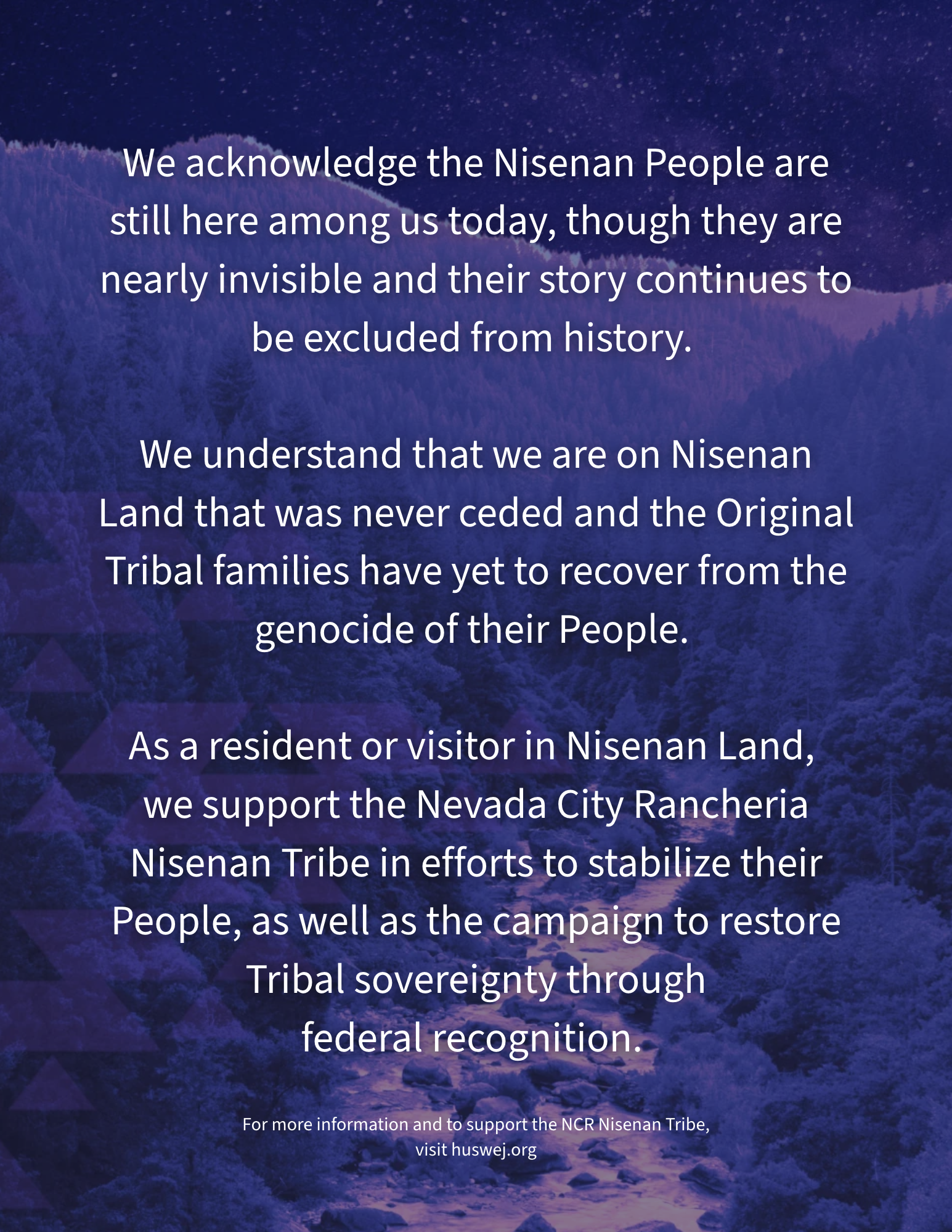
As the season of giving thanks approaches, families and communities will gather to share meals, reflect on the people and places that sustain their lives, and express gratitude for the blessings of another year.
For many, this season also brings an invitation to acknowledge the Indigenous Peoples whose Ancestral Homelands they inhabit. Land acknowledgements have become increasingly common at community gatherings, public events, and around holiday tables, offering opportunities to recognize the Original Peoples of these Lands and their enduring presence today.
Even a simple acknowledgment can be meaningful. Each time someone hears the name Nisenan, learns something about the Tribe’s history, or recognizes the Tribe’s continued presence in its Ancestral Homelands, another piece of long-erased history becomes visible.
Yet acknowledgement also invites deeper reflection:
What does it truly mean to acknowledge the Nevada City Rancheria Nisenan Tribe?
How might an acknowledgement become the beginning of a more meaningful relationship with the history, People, and Land it seeks to honor?
And what opportunities for meaningful action emerge when that history becomes better understood?
Acknowledgement Begins with Truth
To acknowledge something is to recognize its existence, to see it, and to hold it as true.
For the Nevada City Rancheria Nisenan Tribe, acknowledgement represents an important first step toward greater visibility, understanding, and recognition of a history long excluded from the broader public consciousness.
For generations, Nisenan People have carried the knowledge of their history and this Land, despite its erasure from the broader historical narrative, including the devastating impacts of the California gold rush, genocide, displacement, forced assimilation, and the systematic erasure of their identity, Culture, and presence from the historical record.
When the Tribe first began sharing its history more publicly, its accounts were often met with skepticism, disbelief, and resistance. Beyond navigating the ongoing impacts of these injustices and carrying the burden of remembering a history that the broader community had largely ignored, the Tribe faced the additional challenge of having to defend and substantiate truths that had been deliberately obscured from the public historical narrative.
This is where acknowledgement can begin to shift that burden.
Acknowledgement begins when others become willing to witness, honor, and share in holding that history.
When more people become willing to learn, remember, and speak accurately about what happened here, the responsibility of preserving and sharing these truths no longer rests solely with the Tribe.
This collective witnessing creates space for understanding, solidarity, and the possibility of meaningful change. It means listening to the stories that have been silenced, challenging inherited narratives, and recognizing that the history of the Sierra Foothills did not begin with the discovery of gold.
This form of acknowledgement invites us to remembrance, witnessing, and truth-telling: to recognize that, for thousands of years before settlers arrived, the Nisenan lived in deep relationship with these Lands, cultivating sophisticated systems of ecological stewardship, Cultural knowledge, ceremony, and community life.
It also means bearing witness to the devastation of colonization, which disrupted entire ecosystems and relationships among People, Plant and Animal-kin, waterways, and the spiritual and Cultural practices that sustained them.
Understanding Our Place Within History
Learning the history of this Land and its Original Peoples also invites a deeper consideration of what it means to belong to a Place, and to recognize that every life exists within a much longer history of relationships, events, and experiences that have shaped the present.
In many ways, this acknowledgement is similar to the practice of honoring Elders and ancestors. Remembering those who came before is an expression of respect and gratitude, recognizing that the lives lived today have been shaped by the knowledge, relationship, and experiences of previous generations.
The same principle can extend to understanding the history of the Land itself, honoring the People and relationships that preceded the present and continue to shape it.
Yet this inheritance also includes the devastating consequences of colonization. The dispossession of Indigenous Peoples helped shape the establishment of the state of California and the United States as we know it today (as the gold from Nisenan territory helped fund and win the Civil War), creating the institutions, systems, and patterns of land ownership whose impacts continue to inform our modern lives.
To acknowledge this history is to recognize that the present cannot be separated from the past. The Places people inhabit, the opportunities available to them, and the relationship they hold with the Land are all shaped, in different ways, by what came before.
Acknowledging difficult histories does not diminish the experience of gratitude. Rather, it can deepen that gratitude, grounding the appreciation for the present in a fuller, more True understanding of the People, relationships, and histories that are deeply embedded in this Place.
From Acknowledgement to Restorative Action
Recognizing how the past continues to shape the present also invites consideration of what justice and repair might look like today.
For the Nevada City Rancheria Nisenan Tribe, the questions have immediate implications. Despite generations of advocacy, the Tribe continues to fight for the restoration of its federal recognition, which was terminated in 1964. The consequences of that termination continue to affect the Tribe’s access to resources, governmental authority, and ability to exercise sovereignty.
The restoration of federal recognition, the rematriation of Ancestral Homelands, and the advancement of Tribal sovereignty are all connected to questions of restorative justice and repair. These are ongoing issues rooted in historical decisions whose consequences continue to shape the Tribe’s present circumstances.
While individuals living today may not have perpetrated these historical injustices, the institutions and systems responsible for them continue to exist. Governments and public institutions have a responsibility to address the enduring consequences of their actions, while individuals and communities can contribute through advocacy, solidarity, and support for meaningful change.
Acknowledgement, then, becomes an invitation to consider how understanding the past can inform the choices, relationships, and aligned actions that shape the future.
Putting Acknowledgement into Practice
The Nevada City Rancheria Nisenan Tribe and HUṠWEJ have spent years creating opportunities for the broader community to engage with Nisenan history, Culture, and contemporary Tribal life.
These resources provide meaningful pathways for transforming acknowledgement into ongoing learning, reciprocal relationship, and tangible support.
HUṠWEJ invites community members to begin, or deepen, their practice of acknowledgment through three interconnected commitments:
Explore the Tribe’s educational resources, films, historical materials, and Cultural storytelling. Attend Nisenan Heritage Day and Orange Shirt Day events, visit `UBA SEO: Nisenan Arts & Culture, and engage with exhibitions that center the Tribe’s own voice and perspectives. Learning is an ongoing practice that helps dismantle misinformation and deepen understanding.
Participate in the Tribe’s ongoing work through volunteering, donating, and supporting the Ancestral Homelands Reciprocity Program (AHRP). These contributions provide tangible resources for Cultural revitalization, land stewardship, Tribal wellness, and the long-term sustainability of the Nisenan community.
Share accurate Nisenan history within personal and professional networks, advocate for the restoration of federal recognition, challenge narratives that perpetuate Indigenous erasure, and support policies and initiatives that advance Tribal sovereignty and self-determination. Meaningful allyship takes many forms, guided by the priorities and leadership of the Tribe.
Each of these actions contributes to a broader movement toward Right Relationship, rooted in truth, reciprocity, and respect.
Holding Truth and Hope Together
Acknowledgement asks us for an honest reckoning with difficult histories, while also creating space to recognize the extraordinary strength, creativity, and possibility unfolding today.
At Yulića, 237 acres of rematriated Nisenan Ancestral Homelands are becoming a place of renewed Tribal community life, Cultural gathering, intergenerational learning, Ceremony, and ecological restoration. These expressions of Cultural resurgence and revitalization demonstrate the possibilities that emerge when historical understanding is accompanied by meaningful support and action.
During this season of thanks-giving, HUṠWEJ invites the broader community to consider the histories and relationships that make life in this region possible, the truths that deserve to be remembered and shared, and the future that collective action can help shape.
May acknowledgement deepen understanding.
May understanding inspire meaningful action.
And may that action help create a future in which Nisenan Land, Culture, and community thrive for generations to come.